A board I’ve been working with recently approved a special assessment of just under $1,000 per home.
Five hundred homes. A twenty-year-old community. A pond that has been quietly filling with sediment since the day the last house closed.
Board members have received threats over it.
Not angry emails. Threats.
And here is what I want every board reading this to sit with: not one person on that board created this problem. They inherited it, they’re the ones holding the deed when the bill came due, and they’re the ones taking the abuse for it.
The number that should have been
Let me give you the arithmetic, because the arithmetic is the whole article.
The dredging project is roughly $400,000. That volume of sediment did not arrive last year. It accumulated over twenty years, at a rate that was entirely predictable from the day the basin was cut.
So the honest annual cost of that pond was about $20,000 a year.
Across 500 homes, that’s $40 per home per year.
$3.33 a month.
Three dollars and thirty-three cents a month, collected quietly from the beginning, and there is no assessment. No letter. No threats. No board member wondering whether volunteering was a mistake.
Instead: just under $1,000, all at once, from people who mostly weren’t there when the obligation was created.
What “fair share” actually means
This is the concept I wish every board understood before their first budget meeting, and it isn’t mine. It’s the principle underneath every properly built reserve study.
Reserve funding is not saving for the future. It’s paying for the deterioration you are consuming right now.
The roof is wearing out while you live under it. The asphalt is failing while you drive on it. The pond is filling with sediment while you look at it.
So the fair-share question is simple: did you pay for the portion of each asset’s life that you personally used up?
When an association funds reserves properly, every owner pays for the share they consumed during the years they owned. When it doesn’t, something quieter happens. Owners who sold in year eight took the full benefit of a functioning amenity and left without paying for the part of it they used.
Someone eventually pays. It’s just never the person who used it.
A special assessment isn’t a new cost. It’s an old bill, finally presented, to whoever is standing there when it arrives.
Why it’s always the pond
Here’s the part that surprised me the first time I worked through it, and it’s why I don’t think anyone acted in bad faith.
In this community, three things went wrong, and all three are structural.
The reserve study had no reliable number for dredging. Reserve specialists are very good at roofs, asphalt, pool equipment and fencing — assets you can see, measure and age by looking at them. Nobody can look at a pond and tell you how much storage it has lost — or where the sediment sits, or what it is made of. Without a full hydrographic survey, there is no defensible number to put in the schedule, so the line is either omitted or filled with a placeholder nobody trusts.
The developer handoff didn’t include a usable O&M manual. Not out of malice — there is simply no standard requiring that the operations and maintenance obligations of a stormwater asset be documented and transferred in a form a volunteer board can act on. The community inherited the asset. It did not inherit the instructions.
And the pond’s honest line item was large enough to be inconvenient. This community collected about $620,000 in total reserves over twenty years. That’s $62 per home per year — for everything. The pond alone needed $40 of that.
Read that again. Funded honestly, the pond would have consumed roughly two-thirds of their entire reserve contribution.
I’m not suggesting anyone made a deliberate decision to leave it out. I’m suggesting that a line item that large, attached to an asset nobody can measure, with no manual explaining why it matters, is the line most likely to quietly not make the cut — twenty years ago, and in a lot of communities still.
Dues stayed artificially low. Everybody felt good about it. The sediment kept accumulating anyway.
The mistake happening right now
There’s a second problem in this story, and it’s the one I’d most like to prevent in your community.
That board handed the dredging project to their community manager to architect and manage.
I want to be careful here, because this is not a criticism of community managers. It’s a criticism of putting one in an impossible position. Nobody hired a community manager for their sediment expertise. Nobody should expect it of them. Asking a manager to scope, price and oversee a six-figure engineered dredging project is like asking your bookkeeper to design the retaining wall.
And here’s why it matters more than it might seem.
The number in a special assessment has to be right the first time.
A board that assesses $1,000 a door and then discovers the project actually costs $1,400 has to go back to the same owners — the ones already making threats — and ask for more. That is not a budgeting problem. That is the end of a board’s credibility, and sometimes of its members’ willingness to serve.
An accurate assessment starts with an Engineer’s Opinion of Cost built on measured conditions: a full hydrographic survey establishing where the sediment is, what type it is, how much sits in each location and how much water stands above each deposit; a plan for how that material gets removed, dewatered and disposed of; and the permitting and access realities that drive the real number. That’s engineering work. It should be done before the assessment is voted on, not discovered afterward.
The architect and the builder
There’s a distinction underneath all of this that determines whether a board’s money buys an outcome or just activity.
dredgeSMART is the engineer on a dredging project. We are not the dredging contractor.
Think about building a house. The architect designs the outcome — what the house must be, what it will cost, when it will be done. The builder executes that design. The homeowner gets what they expected because somebody independent of the construction defined the result first and then held the work to it.
Nobody builds a custom home by calling three framers and taking the lowest bid.
But that is almost exactly how dredging gets bought. A board collects quotes from dredging contractors and picks one. They have hired a builder with no architect — and then they’re surprised when the finished pond isn’t what they pictured, the number moved, or the schedule slipped.
A contractor’s quote is not a plan. It’s a price for an activity, usually expressed as a cubic yard rate, a day rate, or a list of line items. None of those is an outcome. A cubic yard rate tells you what it costs to move material. It doesn’t tell you how much material has to move, where it sits, whether that methodology suits what’s down there, or what the pond will actually hold when the work stops.
That’s why every piece of dredging engineering we do is built around the client’s desired outcome — the storage you need back, verified against survey — and not around a unit price. We define the result, we design to it, and the contractor executes against a design that already has your answer in it.
If you’re already here
Some of you reading this are in exactly this position right now. You can’t un-defer twenty years. There is no painless option left. There are only better and worse ways through it.
Get a real Engineer’s Opinion of Cost before you set the assessment number. Bring in the engineer before you talk to a contractor, not after. One accurate ask is survivable. Two is not.
And then, the part that actually fixes it
The one-time project is not the solution. It’s the correction. The solution is making sure the next board never has this conversation.
First, raise dues to reflect fair share. Work with your reserve study specialist and put a real, defensible pond number in the schedule — built on a measured accrual rate rather than a guess. This is an uncomfortable meeting and it is far less uncomfortable than the one the current board is having.
Second, subscribe to the dredgeSMART Dashboard so sediment stops accumulating invisibly. The Dashboard is where the long-term monitoring and decision-making data lives for your leadership team and your board. It tells you three things on a standing basis: the current state of the asset, the rate of sedimentation, and the projected cost and date of the next dredging event — the point at which accumulation crosses your sediment tolerance limit.
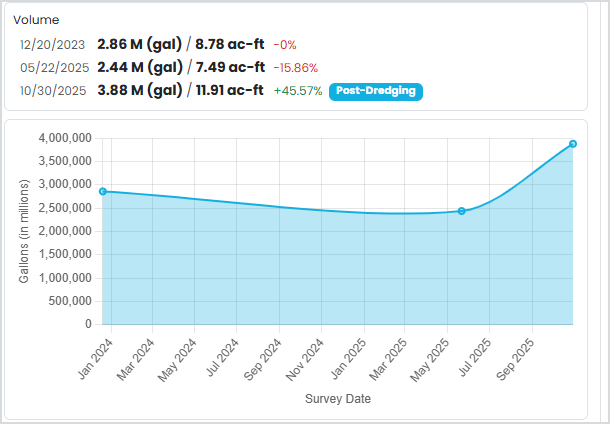
Figure 2. Volume tracked across successive surveys. The decline from 8.78 to 7.49 acre-feet is the accrual rate — the number a reserve study has never been able to get for a pond. The step up to 11.91 acre-feet is a completed dredging project, verified by survey rather than asserted by invoice.
That third one is the whole game. It converts an unknowable future emergency into a dated line item with a dollar figure attached — which is exactly the input your reserve study specialist has never been able to get for a pond.
And when you know your accrual rate, you stop waiting twenty years for one catastrophic project. You do smaller maintenance dredging on a cycle, at a fraction of the cost, and — this is the part boards miss — the pond actually functions the whole time. It holds the storage it was engineered to hold, continuously, instead of performing well for a year or two after a massive project and then degrading for the next eighteen.
That’s the difference between a capital emergency every generation and a line item nobody argues about.
The only asset you can’t see depreciating
Walk your property and you can age almost everything on it. The roof looks like what it is. The asphalt tells you how much life is left. The fence, the pool equipment, the paint — all of it is visible, and all of it is in your reserve study.
The pond looks exactly the same at 100% of its design storage as it does at 60%.
That’s not a minor inconvenience. That’s the entire reason this keeps happening. The one asset in your community that degrades on the most predictable schedule is the only one you cannot inspect by looking at it — so it’s the one that falls out of the reserve study, and the one that comes back as an assessment letter.
Unless somebody measures it.
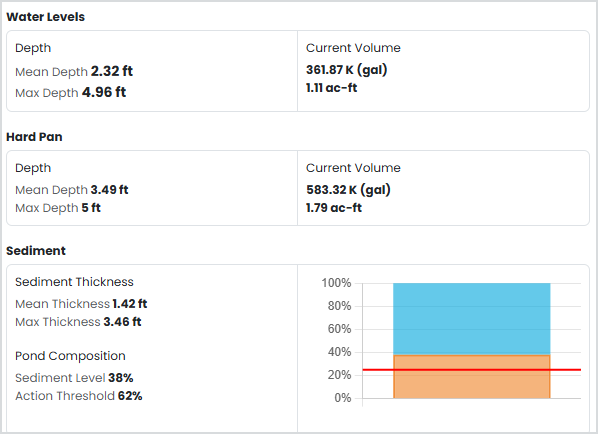
Figure 1. The same pond, measured. Mean sediment thickness 1.42 ft, max 3.46 ft. Sediment now occupies 38% of the basin against a 62% action threshold. From the bank, this pond looks fine.
Your pond is not a pond. It’s infrastructure. And it has been depreciating since the day it was built, whether or not anyone wrote it down.
Where to start
If you’re a board member, a community manager, a municipal leader or a golf course GM and you genuinely do not know how much storage your water body has lost, you are not behind — you’re in the majority. You just don’t have the number yet.
Get a full hydrographic survey. Not bathymetry alone — bathymetry gives you water depth and nothing else, and water depth by itself can’t tell you what you’re about to pay for.
A hydrographic survey tells you four things: where the sediment is located, what type of sediment it is — which determines the dredging methodology, and therefore the cost — how much of it sits in each location, and how much water stands on top of each deposit. Together, those four give you the actual current state of the asset. Any one of them missing and you’re back to a guess wearing a number.
And if an as-built drawing still exists in your records, pull it. That tells us what the basin was engineered to be, which means the project restores the pond to a design standard rather than to somebody’s memory of how it used to look.
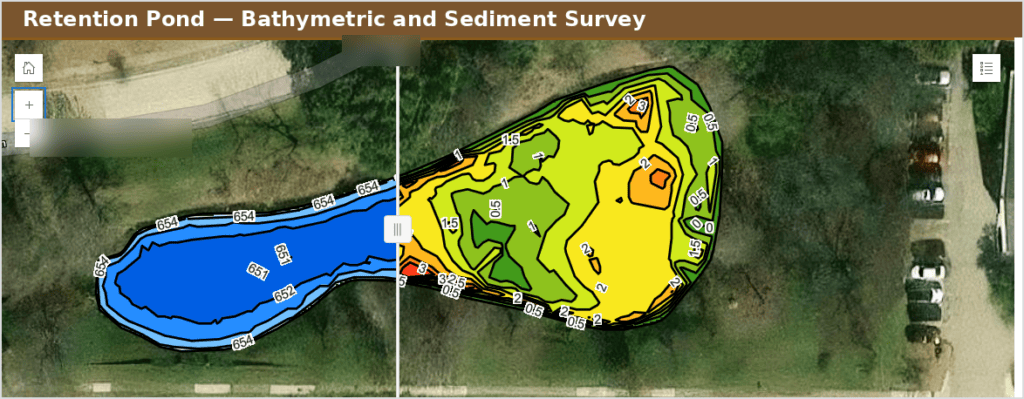
Figure 3. Water depth on the left, sediment thickness on the right — the same basin, same survey. The left panel alone would tell a board how deep the water is. Only the right panel tells them what it will cost to get the storage back.
That’s where dredgeSMART starts every engagement: Discovery, then Engineering, then Project Execution — in that order — and then the Dashboard, which is what keeps Discovery from going stale the moment the dredge leaves. We won’t tell you what a project costs before we know what’s down there, because a guess can’t go into a reserve study and a measured rate can.
And to be clear about what you’re buying: our customers receive a guaranteed outcome. They are not paying for activity, tasks or line items. For dredgeSMART that means an agreed result — capacity restored and verified against survey — not a day rate on a dredge and a hope that the number lands near the estimate.
If the honest answer is that you have good years left before you need capital, we’ll tell you that, and you can put the small number in the budget while it’s still small.
We bring life to surface water and the people it supports. Your success is our passion.
Trent Lewis, FPC — Chief Visionary Officer, PondMedics Family of Brands