Sixty-two days
As of 16 September, DFW Airport has gone 62 consecutive days without measurable rainfall. August produced a trace. It is the third-longest dry streak in the record, and it is still running. Second place is 67 days from 2022, and the all-time mark is 84 days set in the summer of 2000.
Somewhere in that stretch, community managers across North Texas started getting the same call. Fish along the shoreline. Residents with photographs. A board asking what happened.
Almost everyone assumes the worst: pollution, a spill, neglect. Almost everyone is wrong. Late summer fish kills during drought usually have a far more ordinary cause.
What a drought does to a pond
A pond in a dry spell is not simply a smaller pond. It is a chemically different one.
The water level falls, and the nutrients stay. Phosphorus and nitrogen that came in over the spring do not evaporate. They concentrate into a shrinking volume, so the same nutrient load becomes a far higher nutrient concentration week by week.
The water superheats. Less volume means less thermal mass, and forty-odd days over 100 degrees drives surface temperatures up and holds them there. Warm water also holds less dissolved oxygen than cool water, so the buffer gets thinner exactly as demand rises.
The margin disappears. A deep pond can absorb a bad week. A pond that has lost a third of its depth to drawdown, on top of whatever it has already lost to sediment, has very little capacity to absorb anything.
Concentrated nutrients, superheated water, and no margin is the precise recipe for a blue-green algae bloom. And that is where the fish start dying.
It is often poisoning, not suffocation
This is the part most people get wrong, including plenty of people in this industry.
Blue-green algae are not really algae at all. They are cyanobacteria, and unlike the green algae everyone pictures, many of them produce toxins. Microcystins are the ones most often found in North Texas ponds. Those toxins kill fish directly.
That means a late summer fish kill during drought is frequently not an oxygen event. It can happen in water carrying perfectly adequate oxygen. The fish were poisoned.
It is worth saying plainly because the response is different. You cannot aerate your way out of an acute toxic bloom that is already underway, and treating the surface does nothing about the conditions that produced it.
How to tell which one you had
There is a field read that costs nothing and will point you in the right direction before anyone takes a sample. Look at what died.
- Only the big fish, and the small ones are fine. That points to dissolved oxygen. A larger fish carries a higher absolute oxygen demand, so when oxygen falls the biggest fish in the pond go first. A kill that is selective by size is usually an oxygen event.
- Everything died, all sizes, all species. That points to a toxin. A poison does not care how big a fish is or what species it belongs to. When the whole population goes down together, more than likely something toxic took them out.
It is a field indicator, not a laboratory result, and the two overlap: a dense bloom that collapses will crash the oxygen overnight as it decomposes, so you can get both in the same week. But it will tell a manager within about five minutes which conversation they are having, and it should shape what gets tested.
Before anything else: people and dogs out of the water
If there is an active blue-green bloom, this comes before the fish, before the board meeting and before the press.
Cyanotoxins are hazardous to people and they kill dogs. A dog that swims through a bloom and then licks its coat can ingest a lethal dose, and it moves fast enough that there is often no time to get to a vet. Keep residents and pets away from the water, post it at every access point, and say so plainly in whatever notice goes out about the fish.
No board has ever regretted over-communicating this one.
When the rain finally comes
The streak will break. When it does, a second risk arrives with it, and communities that just went through a bloom are the most exposed to it.
Through a long hot stretch a pond stratifies hard: warm oxygen-rich water on top, cooler water beneath that has been cut off from sunlight for weeks while organic material, including a summer’s worth of dead algae, sinks into it and decomposes, consuming whatever oxygen is down there. By September the bottom of your pond is close to lifeless and nothing at the surface shows it.
A heavy, cool rain mixes those layers in a few hours. The oxygen-starved water comes up and blends with the water the fish are living in, and average dissolved oxygen collapses. Fish that were fine on Saturday are gasping or dead on Sunday.
So the drought-breaking storm can deliver the second kill of the season to a pond that already had one. The storm will get the blame. The oxygen debt was built over the preceding two months.
What to tell residents
Explain the mechanism in plain language, and do it quickly. Most late summer fish kills during a drought are natural events driven by heat, concentration and oxygen, not contamination, and residents given the actual explanation settle far faster than residents given silence or a vague reassurance.
Then be honest about the second half. If this is not the first time, the pond is telling you something about its nutrient load, its depth or its circulation, and residents deserve to hear that the community is looking at the pattern rather than treating each event as bad luck.
What actually prevents the next one
Three things drive the risk of late summer fish kills during drought, and none of them is the weather.
The nutrient load. Runoff from lawns and landscaping feeds the material that blooms and then decomposes. Managing that load across the season (and watching concentration rise as the water drops, rather than testing once in spring) is what gives a community warning before a bloom instead of after it. That is Simple Pond Care: subscription water-quality management with monitoring and reporting, treatment delivered precisely through AquaInject rather than applied by eye.
The depth. Volume is your buffer against everything above. A pond that has lost storage to sediment starts every summer with less margin and ends it with a bloom. When enough depth has gone, that is dredgeSMART, measured against the original design volume with bathymetric survey data rather than guessed.
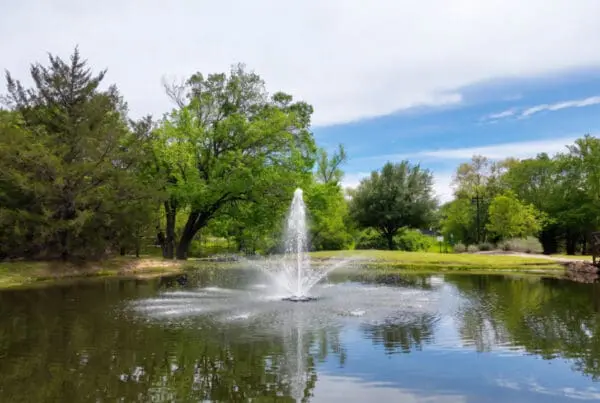
The oxygen at the bottom, and this is where most communities get it wrong. A floating fountain is a display. It is there because moving water looks good and sounds good, which is a perfectly legitimate reason to own one. What a fountain is not is an aeration device. It does not oxygenate your pond, it does not break the thermal layering, and it should not be counted on for water quality at all. If your pond depends on a fountain for its oxygen, your pond is not aerated.
Bottom-diffused aeration is different equipment entirely. It sits on the floor of the pond and releases fine bubbles that rise through the whole water column, and it does three things a fountain cannot.
- It destratifies the pond. It breaks the thermal layering that sets up a turnover kill. A fountain does not do this at all.
- It carries oxygenated water to the bottom. The rising column lifts anoxic bottom water and mixes oxygenated surface water down into it, until the oxygen profile is roughly uniform top to bottom instead of rich at the surface and dead at depth.
- It locks up the phosphorus. This is the one almost nobody explains, and it is the most important. When sediment goes anoxic, iron releases the phosphorus it was holding and that phosphorus goes into the water column, where algae and rooted plants feed on it. Keep oxygen at the sediment surface and the reaction runs the other way: the iron binds the phosphorus and sequesters it in the sediment, where nothing can use it.
That last point is the whole argument. A pond that recycles its own phosphorus every summer will bloom no matter how much you treat the surface, because it is fertilizing itself from the bottom. In a drought year, when every nutrient is concentrating anyway, internal loading is what turns a bad summer into a toxic one.
Both the fountain and the aeration system come from Fountain Freedom, and we keep them straight: the fountain is the amenity your residents see, the aeration is the equipment that keeps the water alive. On floating fountains, the promise is in writing: no more than seven downtime days in a month, or we do not collect that month’s subscription.
How much of your nutrient problem is internal loading from the sediment versus what is washing in from the watershed depends on your sediment chemistry. We assess it rather than assume it, because it changes what we would recommend.
How we work it
This is The PondMedics Way.
- Listen. What died, what size, when, and what the water has done over the last sixty days.
- Innovate. Look at nutrient concentration, depth and the sediment rather than blaming the most visible thing.
- Propose. A plan against what is actually driving the risk, with a number you can budget.
- Deliver. Specialists, not laborers, remove the dead fish.
- Feedback. We ask what the board and the residents noticed.
- Follow-up. A pond that bloomed once will bloom again until the conditions change, so we stay on it.
What a recovered pond looks like
It looks like nothing, which is the point. The water holds through August. The bloom does not come. Nobody photographs the shoreline, the dog swims, and the board talks about something else.
If your community has had a kill this summer, or is watching the water drop and wondering, start with an assessment. We look at nutrient concentration, depth, sediment and oxygen, and tell you which one is driving it. If the honest answer is that you need aeration rather than dredging, that is what we will say, even though it is the smaller job.
We bring life to surface water and the people it supports. Your success is our passion.
FAQs
Why are fish dying when there has not been any rain?
Because drought is its own mechanism. Falling water levels concentrate nutrients, the water superheats and holds less oxygen, and eutrophic ponds bloom. Blue-green blooms produce toxins that kill fish directly. It does not take a storm.
How do we know if it was a toxic bloom rather than low oxygen?
Start with what died. Only the larger fish dead and the smaller ones surviving points to dissolved oxygen, because bigger fish have a higher oxygen demand and go first. Every size and every species down together points to a toxin. Confirm by testing, but that read tells you within minutes which problem you are managing.
Is the water dangerous to people and pets?
Treat an active blue-green bloom as dangerous until told otherwise. Cyanotoxins cause illness in people and are frequently fatal to dogs, which ingest them licking their coat after swimming. Keep people and animals out and post the access points.
Will a fountain prevent this?
No. A fountain is decoration. It is not an aeration device and it will not protect your fish. Buy one because you want the look of moving water. If you want to reduce the risk of a kill, that is bottom-diffused aeration, which is different equipment entirely.
Should we be worried about the first big rain?
Yes, and it is worth planning for. A long dry stretch leaves a pond sharply stratified with an oxygen-poor bottom. The first heavy, cool rain mixes those layers and can collapse dissolved oxygen within hours. A pond that has already had a bloom this summer is the most exposed.