A pond dam repair guide sounds technical until the moment your pond starts losing water, your shoreline begins to slump, or you notice wet spots creeping down the back slope of your dam after a storm. At that point, it becomes urgent. The question most DFW pond owners ask is: what is actually wrong, and how serious is it? The answer depends on where the problem started – and catching it early almost always determines whether you are looking at a manageable repair or a much larger structural project.
We are PondMedics, a Dallas/Fort Worth-based boutique pond, lake, and surface water resource engineering, management, and consulting firm serving all of North Texas and the South Central U.S. We are DFW’s resource for complete pond and lake care. Our Pond Issues service is built specifically for the kind of root-cause diagnostics and repair work that dam problems demand – before a slow leak becomes a failure.
What a Pond Dam Actually Does
Before diving into repair strategies, it helps to understand what your dam is managing. A pond dam is not just an earthen wall holding water back. It is an engineered structure designed to retain water at a specific level, move water safely through inflow and outflow structures during storm events, protect downstream areas from uncontrolled discharge, and maintain its own structural integrity under constant hydrostatic pressure. When any part of that system fails – whether it is the embankment, the outlet pipe, the spillway, or the soil core – the entire system is under more stress than it was designed to handle. That is why pond dam repair needs to be treated as an engineering problem, not just a maintenance task.
What Are the Most Common Signs of Pond Dam Damage That Need Repair?
Most DFW pond owners do not realize their dam has a problem until the signs have been building for months. Knowing what to look for is the first step in any effective pond dam repair guide. Common warning signs include:
-
- Unexplained or steady drop in water level not explained by evaporation
- Wet or saturated soil on the downstream face or base of the dam
- Sinkholes, soft spots, or depressions forming on top of the dam
- Visible erosion cuts or rills on the dam face after rain events
- Cracking or separation along the crest of the embankment
- Corroded, blocked, or deteriorating inflow and outflow pipes
- Uncontrolled water moving around or through the dam structure
As our Chief Operating Officer, Jarrod Conner, puts it directly: “Inflows and outflows are the things that go first. It’s where water moves the most.” In North Texas ponds, the combination of heavy storm events and expansive clay soils puts extraordinary stress on those structures over time. Catching movement or deterioration at inlets and outlets early is one of the most reliable ways to prevent a small pond dam repair from becoming a major reconstruction project.
Understanding the Root Causes Before You Repair
One of the most common mistakes in pond dam repair is addressing the visible symptom without understanding the underlying cause. A wet spot on the back of a dam looks like a seepage problem. But the actual driver could be a corroded outlet pipe, a failed anti-seep collar, root intrusion from trees on the embankment, or animal burrows from muskrats or beavers tunneling into the clay core.
The most durable pond dam repair work starts with a thorough site assessment that looks at:
-
- The structural condition of inflow and outflow pipes and their connections
- The soil compaction and clay core integrity of the embankment itself
- Vegetation on or near the dam that may be compromising the structure
- Spillway capacity and condition relative to the watershed it serves
- Signs of internal erosion or piping within the dam body
In DFW, where heavy rainfall events can follow extended drought periods that crack and shrink clay soils, the risk of hidden internal damage is higher than many property owners realize. A proper pond dam repair diagnosis accounts for those regional patterns, not just visible surface conditions.
How Do You Fix a Leaking Pond Dam Without Draining It?
This is one of the most searched questions in any pond dam repair guide, and the honest answer is: it depends on where the leak is and how significant the damage has become.
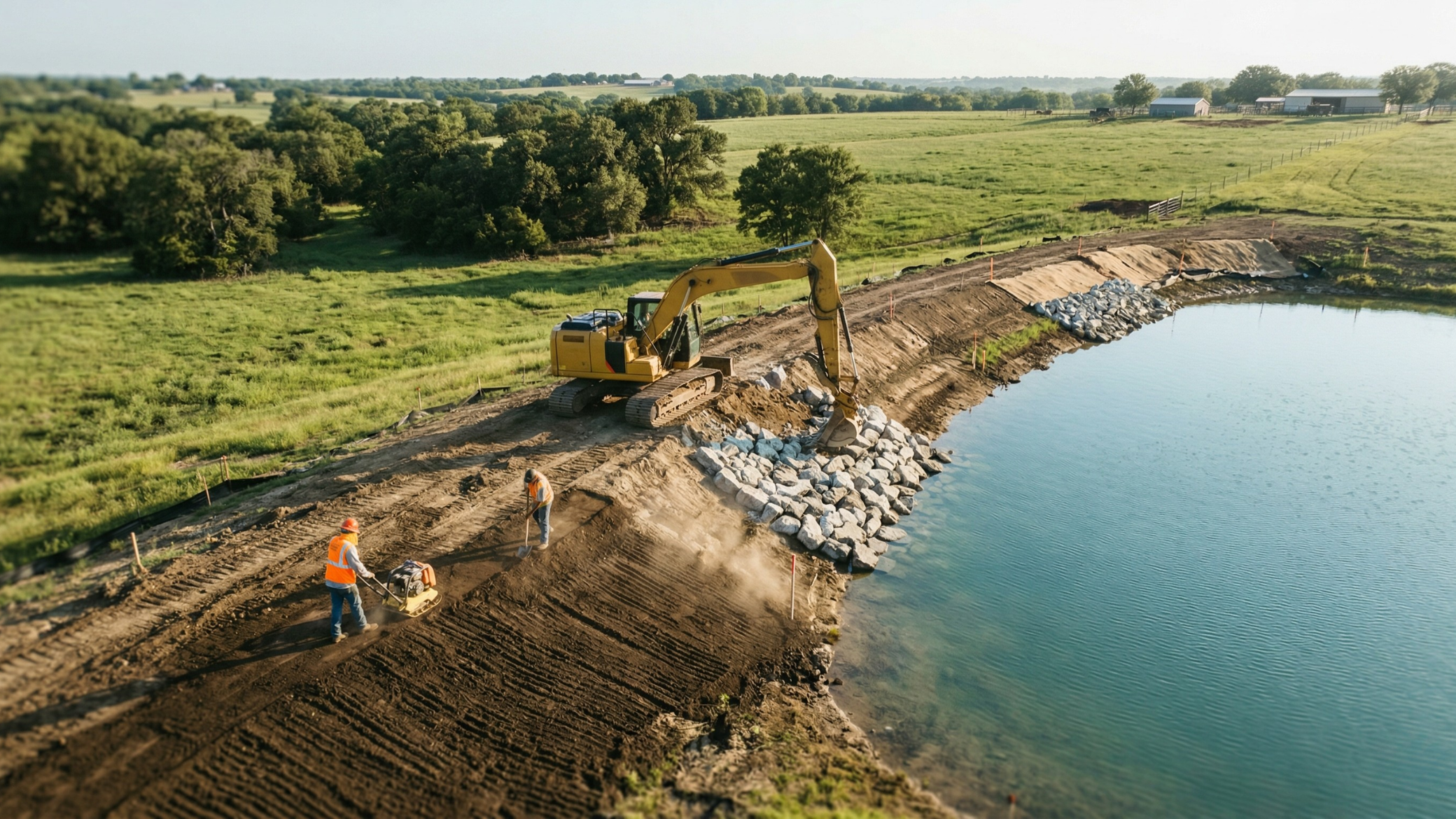
For minor seepage through the embankment face, some repairs can be made with the pond at or near its normal level. Options may include:
-
- Bentonite clay application to seal surface seepage areas from the water side
- Targeted compaction of exposed wet areas on the downstream slope
- Partial drawdown to expose and address specific failure zones without full drainage
However, for more significant structural issues – corroded outlet pipes, failed clay core sections, active piping through the embankment, or damaged anti-seep collars – a controlled drawdown or full drainage is often necessary. Attempting to patch around a failed pipe without proper access is one of the fastest ways to end up repeating the same repair within a few seasons.
How Long Does a Pond Dam Repair Last?
Durability is one of the most important questions a pond owner can ask before committing to a repair approach. The longevity of your repair depends heavily on whether the root cause was correctly identified, the quality of materials and compaction used, whether inflow and outflow structures were properly restored, and how the pond is maintained afterward.
As Jarrod often asks his team: “Is this a five year fix, a 15 year fix, a 50 year fix.” The range is real. A surface patch on an eroded slope may hold for a few years before conditions re-establish the same failure pattern. A properly engineered repair that addresses the clay core, replaces deteriorated outlet infrastructure, and restores spillway capacity can perform for decades.
detention pond serving a commercial site carries different risk and urgency than an amenity pond in a residential community, and the repair strategy should reflect that.
When Pond Dam Repair Connects to Sediment
Dam problems and sediment buildup are more connected than they might appear. As sediment accumulates, water levels rise relative to available storage capacity, increasing the hydraulic load on the dam and spillway. When sediment has become a contributing factor, our DredgeSMART dredging program becomes part of the long-term solution. DredgeSMART provides planning, permitting, and hydraulic dredging services designed specifically for DFW ponds, helping restore storage and reduce pressure on an aging dam.
If aquatic weeds have established themselves along the dam face or in shallow embankment areas, our Aquatic Weeds service can address that vegetation as part of a broader stabilization plan.
Turning This Pond Dam Repair Guide Into a Site-Specific Plan
Every dam in DFW has its own history, soil conditions, watershed size, and downstream risk profile. At PondMedics, we approach pond dam repair the same way we approach every Pond Issues project: start with real diagnostics, match the solution to the actual cause, and build a plan that accounts for how this pond needs to perform over the long term.
If your DFW pond is showing any of the warning signs covered in this pond dam repair guide, contact PondMedics today. Let DFW’s resource for complete pond and lake care help you understand what your dam actually needs – and build a repair plan designed to last.
FAQs About Pond Dam Repair
1. Can I repair a pond dam myself, or do I need an engineer?
Minor surface erosion on a small private pond may be manageable with property owner intervention, but most meaningful pond dam repair in DFW involves structures tied to stormwater systems, downstream drainage, or regulated impoundments. In those cases, professional engineering assessment is not just recommended – it is often required. Misdiagnosing the cause or using the wrong repair method can accelerate failure rather than prevent it.
2. How do I know if my pond dam has internal erosion?
Internal erosion, sometimes called piping, is one of the harder dam problems to detect because it develops inside the embankment before it becomes visible on the surface. Signs to watch for include unexplained turbid or discolored water near the dam face, sudden changes in seepage patterns, or progressive wet spots on the downstream slope that do not resolve after storms. If you observe any of these, treat them as urgent and contact PondMedics for a structural assessment.
3. Does vegetation on the dam face cause damage over time?
Yes – and it is one of the most underestimated contributors to pond dam deterioration in North Texas. Grass maintained at a reasonable height actually helps protect the embankment surface from erosion. The problems come from woody vegetation: trees and large shrubs allowed to grow on the dam introduce root systems that penetrate the clay core, create pathways for water movement, and can eventually compromise structural integrity. “They will deteriorate and fall away,” as Jarrod Conner describes what happens to dam structures when these issues go unaddressed. Keeping woody growth off the dam face is one of the simplest and most effective forms of long-term pond dam maintenance.