Pond bacteria treatment is one of the most misunderstood tools in pond care – and for DFW pond owners, that misunderstanding often costs time, money, and water clarity. Is bacteria treatment a quick fix, or does it require a bigger plan to work? The short answer: it works, but only when it is matched to your pond’s real conditions and paired with the right support systems. Used correctly, it is one of the most natural and sustainable ways to restore balance to a struggling pond.
We are PondMedics, a Dallas/Fort Worth-based boutique pond, lake, and surface water resource engineering, management, and consulting firm serving all of North Texas and the South Central U.S. – DFW’s resource for complete pond and lake care. Across our Aquatic Weeds, Pond Issues, and ongoing management work, we see beneficial bacteria treatment play a meaningful role in healthier, clearer ponds – when it is deployed as part of a real plan, not just poured in and forgotten.
What Pond Bacteria Treatment Actually Does
Beneficial bacteria are naturally occurring microorganisms that break down the organic waste building up in your pond. The primary contributors to that waste include:
-
- Fish waste and decaying plant matter
- Nutrient-rich storm runoff from lawns and parking lots
- Accumulating muck and sludge at the pond bottom
When introduced into a pond, beneficial bacteria go to work in two key zones:
-
- The pond bottom, where organic sediment collects
- The water column, where dissolved nutrients fuel algae growth
By consuming phosphorus and nitrogen – the primary drivers of algae blooms in freshwater ponds – beneficial bacteria starve the problem rather than just treating the symptom.
This is an important distinction. Pond bacteria treatment is not an algaecide. It does not kill algae on contact. What it does is gradually reduce the conditions that make algae so hard to control in the first place. Results typically take 30 to 60 days to become visible, which is exactly why reactive, one-time applications rarely satisfy DFW pond owners hoping for an overnight fix.
How Does Pond Bacteria Treatment Work to Clear Algae and Reduce Sludge?
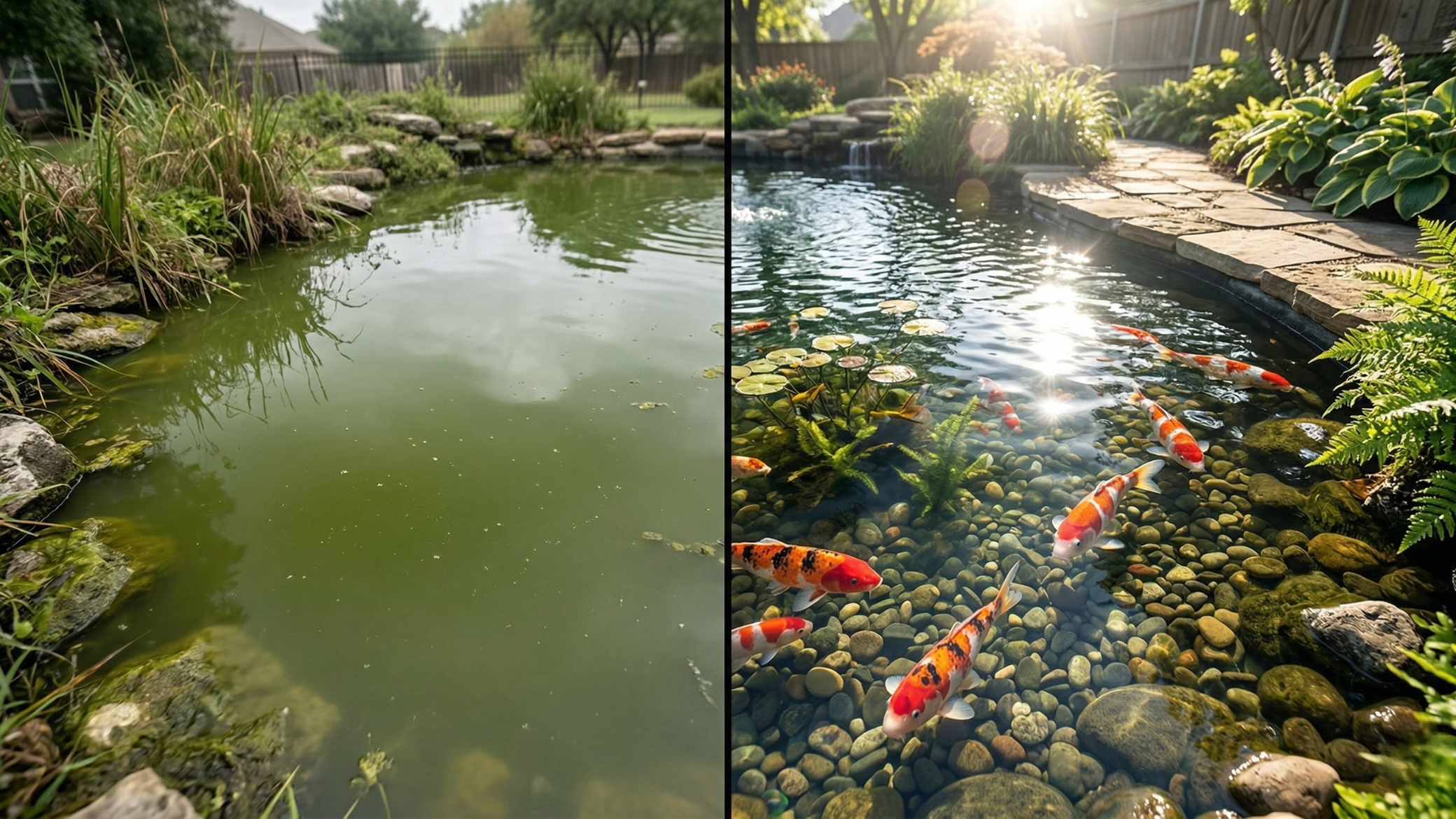
Algae and muck share a common driver: excess nutrients. When organic matter accumulates faster than a pond’s natural ecosystem can process it, the cycle looks like this:
-
- Nutrients build up from fallen leaves, grass clippings, fish waste, and fertilizer runoff
- Algae blooms follow
- The sludge layer at the pond bottom thickens
- Odors develop and water clarity drops
Beneficial bacteria interrupt that cycle by accelerating decomposition. They bind phosphorus and nitrogen into their own cell structures, making those nutrients unavailable to algae. As bacterial colonies grow and spread, they process organic waste that has been piling up over seasons – sometimes years.
For DFW ponds, this matters more than most pond owners realize. North Texas summers bring:
-
- Intense heat that accelerates nutrient cycling
- Slow-moving or stagnant water conditions
- Heavy nutrient loads from surrounding developed land
A well-designed pond bacteria treatment plan, applied early and consistently, can get ahead of those patterns instead of chasing them.
As our Chief Operating Officer, Jarrod Conner, puts it: “We have a proactive approach, a predictive approach to where the cost and the risk and the burden is on us to make sure that we guarantee that the pond is healthy.”
That proactive mindset is exactly what separates ponds that stay clear through a long DFW summer from ponds that require emergency treatments every few months.
When Should You Use Pond Bacteria Treatment in a DFW Pond?
Timing matters. Beneficial bacteria are most effective when water temperatures reach at least 50 degrees Fahrenheit, which in North Texas typically means early spring through late fall. A few general timing guidelines to keep in mind:
-
- Start treatments early in the season, before algae gets a foothold
- Use a higher initial dose for ponds with heavy sludge or a history of algae problems
- Follow with consistent maintenance applications to keep bacterial colonies active
- Watch for early warning signs that conditions are shifting
On that last point, Jarrod says it plainly: “If anything seems off, looks off, smells off, feels off, something’s wrong and you need to get help.”
Odors, sudden changes in clarity, or green water that keeps returning after treatment are all signs that the nutrient cycle in your pond has tipped out of balance. Waiting until problems are visible and serious usually means the pond already has more organic loading than bacteria alone can quickly address – at that point, it becomes one tool in a larger response, not the entire solution.
Does Pond Bacteria Treatment Work Without Aeration?
This is one of the most important questions DFW pond owners ask, and the answer is: bacteria work better with aeration – and in many cases, significantly so.
Most beneficial bacteria formulations are aerobic, meaning they require dissolved oxygen to function at their best. When oxygen levels drop in a stagnant DFW pond during summer heat, bacterial metabolism slows. The same low-oxygen conditions that stress your fish are also the conditions that limit pond bacteria treatment performance.
This is why reliable surface aeration is part of the bacteria treatment strategy, not just an optional add-on. Through our Fountain Freedom brand, we provide fountains as a service for DFW property owners, delivering:
-
- Consistent surface circulation and oxygenation
- Reliable uptime during the long DFW heat season
- Predictable monthly costs without the repair and replacement burden falling on you
When bacteria treatment and reliable aeration work together, results are more stable and longer-lasting than either tool can deliver on its own. A fountain that runs intermittently offers intermittent oxygen support – which, during a heat wave, is not enough to protect a pond that depends on consistent aeration to stay balanced.
When Pond Bacteria Treatment Alone Is Not Enough
There are situations where a pond’s problems run deeper than bacteria treatment can address. Common signs that something more is needed include:
-
- Noticeably shallow or flat areas where depth has been lost to sediment
- Rooted aquatic plant growth spreading across the pond floor
- Persistent odors despite regular bacterial applications
- Heavy algae returning quickly after treatments, season after season
When sediment has built up significantly, the problem is not just nutrient loading – it is habitat. Shallow, sediment-filled ponds heat up faster, support more aggressive plant growth, and limit the circulation that bacteria and aeration need to function effectively.
In those cases, our DredgeSMART dredging program becomes part of the larger picture. DredgeSMART provides planning, permitting, and hydraulic dredging services specifically designed to restore depth and storage in DFW ponds – creating a much better environment for pond bacteria treatment to work going forward.
If aquatic weeds have also become a significant issue, our Aquatic Weeds service can address the plant growth that is often both a symptom and a contributing cause of unbalanced pond conditions.
Building a Pond Bacteria Treatment Plan That Lasts
The biggest mistake DFW pond owners make with pond bacteria treatment is treating it as a one-time solution rather than a consistent management tool. A single application in June will not hold through a North Texas summer with heat, heavy storms, and constant nutrient input from surrounding land.
An effective pond bacteria treatment approach for DFW ponds looks more like a seasonal rhythm:
-
- Early-season inoculation to establish bacterial populations before conditions turn aggressive
- Regular maintenance doses throughout the warm months to keep colonies active
- Reliable aeration support through a program like Fountain Freedom to maximize bacterial effectiveness
- Watchful attention to early warning signs and seasonal shifts
When that rhythm is paired with the right interventions for weeds, sediment, and structural issues, the results compound over time.
If you are tired of fighting the same green water and bad odors every summer, contact PondMedics today. Our team can help you build a pond bacteria treatment plan that fits your specific pond, your site, and the real demands of North Texas weather.
FAQs About Pond Bacteria Treatment
1. How long does it take for pond bacteria treatment to show results?
Beneficial bacteria are a gradual solution, not an overnight one. In most ponds, visible improvements in clarity and odor reduction take 30 to 60 days of consistent treatment. Ponds with heavy sludge accumulation or significant algae issues may take longer, and often benefit from a higher initial dose to establish the bacterial population before shifting to maintenance applications.
2. Can pond bacteria treatment replace algaecides in my pond management plan?
Pond bacteria treatment and algaecides serve different purposes. Bacteria reduce the nutrient conditions that allow algae to grow, while algaecides target active algae directly. In many DFW ponds, a thoughtful combination of both – with bacteria providing long-term nutrient control and targeted algaecide applications managing active blooms – is more effective than relying on either tool alone.
3. How do I know if my pond has too much sediment for bacteria treatment to work effectively?
If your pond has noticeably shallow areas, persistent odors, rooted plant growth spreading across the bottom, or a history of heavy algae despite regular treatment, sediment accumulation may be limiting what bacteria treatment can accomplish. A depth assessment through PondMedics’ DredgeSMART program can tell you whether restoring design depth should be part of your plan before or alongside ongoing bacteria treatment.